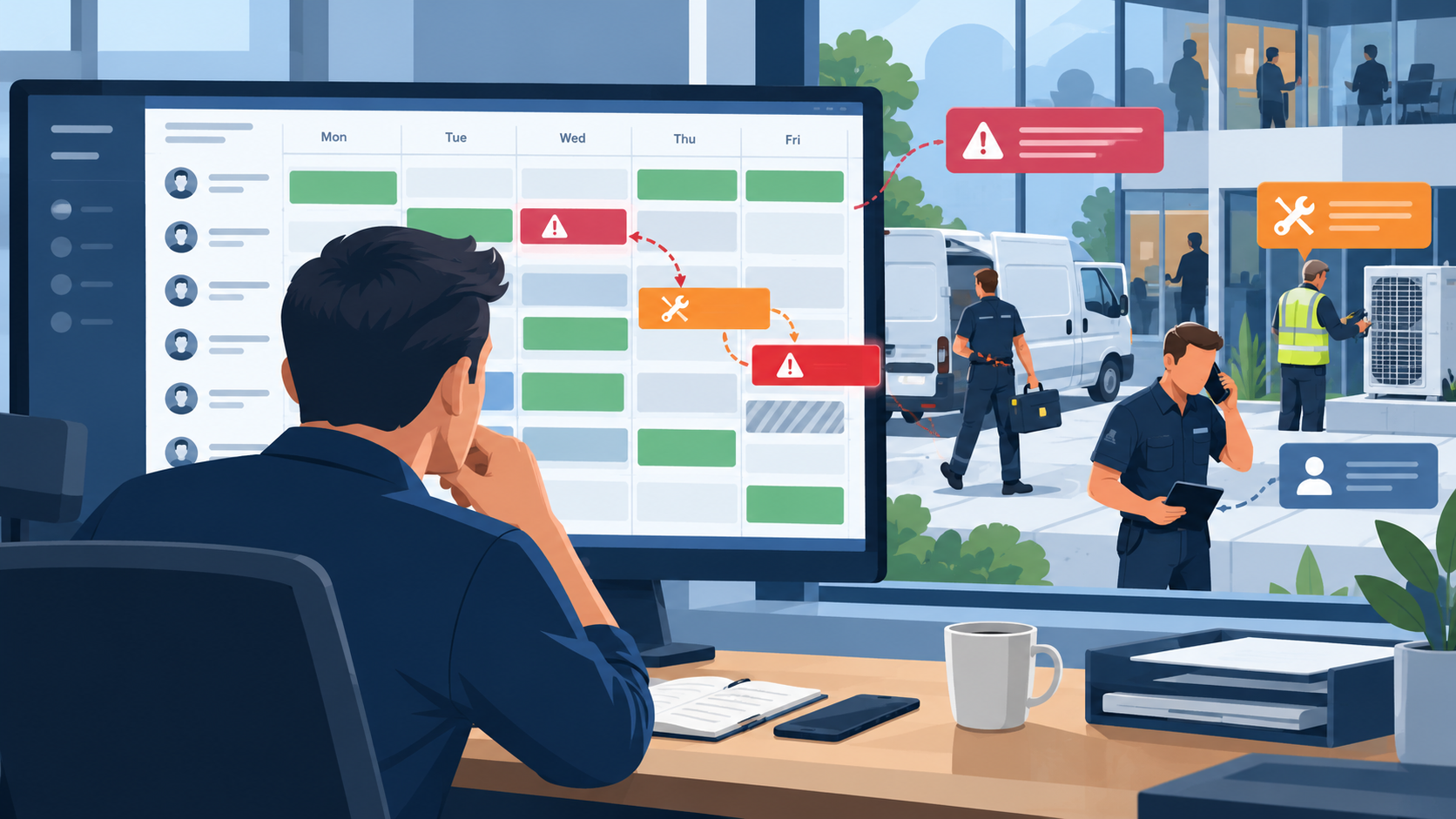
A PPM programme can look well organised on a screen long before it becomes workable in the real world.
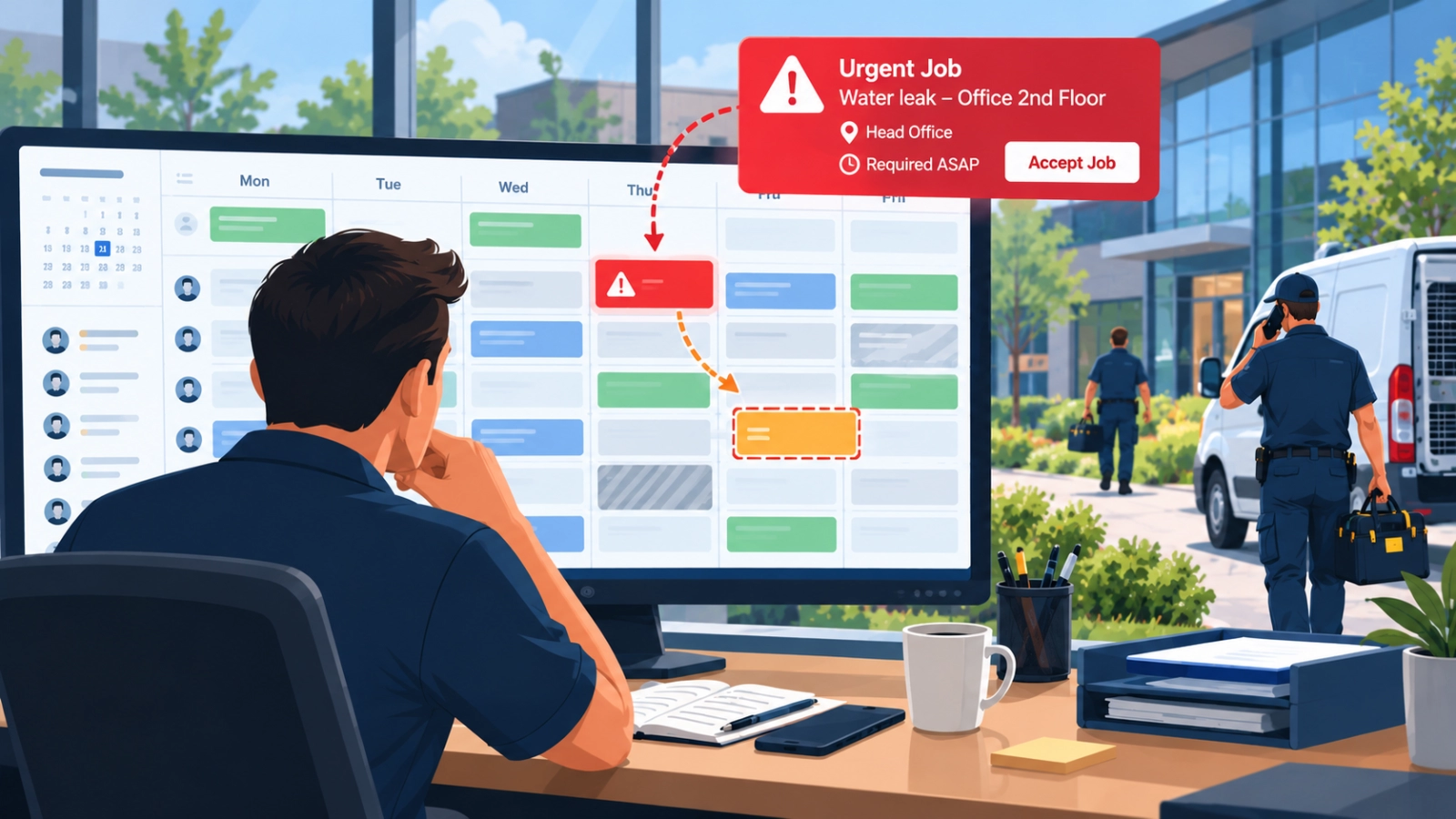
The visits have been generated. Frequencies are in place. Contracts, sites and assets appear on the schedule. Then the working day starts: an engineer is off sick, a customer cannot provide access, a reactive job takes priority, an earlier visit overruns and an appointment has to move.
At that point, the operational problem is no longer how to create recurring work. It is how to protect every other commitment affected by the change.
That is the distinction growing FM providers need to make. Creating a PPM plan is not the same as operating one. A plan gives the business a starting point. Operating the plan means continually testing those commitments against real capacity, making controlled changes when the day changes, and keeping every affected obligation visible.
This is not another guide to what PPM is. If you need the background, see CQ’s guide to planned preventive maintenance in FM. This article is about the harder question: what happens after the recurring schedule has been created.
One PPM programme becomes hundreds of separate promises
A multi-site contract may be sold and administered as one customer relationship. Operationally, it is rarely one thing.
It can include different sites, asset types, service specifications, visit frequencies, site contacts and permitted attendance windows. Some work may be monthly, some quarterly and some annual. One location may allow visits early in the morning; another may require a named contact, security clearance or an agreed appointment. The same customer may expect a single report, while the delivery work is spread across dozens of locations.
That means a PPM programme is not simply a recurring series. It is a large number of individual promises:
- the right task;
- at the right location;
- for the right asset or service requirement;
- by the appropriate date or agreed window;
- with the right person; and
- with a clear record of what happened.
This is why scale changes the character of the problem. A handful of recurring visits can often be held in the experience of a scheduler or contract manager. A growing portfolio cannot. Once a customer’s programme becomes hundreds of individual commitments, the business needs to see whether those commitments are actually deliverable — not merely whether they were generated.
Maintenance guidance reflects this wider view. CIBSE describes maintenance engineering and management as part of operating building services throughout their lifespan, while the International Facility Management Association distinguishes a complete programme from a simple task list by including asset information, task libraries and feedback on whether work happened.1
For an FM provider, the schedule is where those elements meet the working day.
A schedule has to fit usable capacity, not headline headcount
It is easy to say that a business has ten engineers available next week. It is much harder — and much more useful — to decide whether it has the capacity to deliver the work promised.
Usable capacity is more than the number of people on payroll. It includes whether the right engineer has the relevant skill or authorisation, whether they are genuinely available, where they will be, how long the visit should take, whether the site can receive them and what other work must be protected.
A visit may look possible in a calendar but still be impractical because:
- the appropriate engineer is on annual leave, training or sickness absence;
- the person with the necessary competency is already committed elsewhere;
- the journey between sites makes the sequence unrealistic;
- the customer only permits attendance within a restricted window;
- the earlier job is likely to take longer than planned;
- access, parts or specialist equipment have not been confirmed; or
- the schedule has no room left for the urgent work that is likely to arrive.
The result is often a calendar that is technically full but operationally fragile.
This is not an argument for trying to create a perfect schedule. FM operations do not work that way. It is an argument for knowing, before a commitment is at risk, where the pressure sits and what capacity is genuinely available to absorb it.
A practical schedule therefore needs to answer more than “who is booked?” It needs to answer “who can complete this obligation, in the required conditions, without creating an unseen problem elsewhere?”
Exceptions are normal. Losing control of them is not.
A large PPM programme will always encounter exceptions. Engineers become unavailable. A site cancels access. A customer asks to move a visit. An urgent reactive job takes priority. An inspection identifies work that needs longer than expected. A job cannot be completed because information, materials or a specialist resource is missing.
The issue is not that these things happen. They are part of running an FM operation.
The issue is what happens next.
If the response is simply to drag an appointment to another day, the business may not know what that move has displaced. It may also lose the connection between the original contractual obligation and the new date. A job can then look rescheduled while its wider consequences remain invisible.
A published university facilities-maintenance model makes the principle clear: planning and scheduling are used to create a structured flow of work, identify backlog and manage resources. In that model, same-day work is handled separately and rescheduled work is prioritised within the scheduling queue.3 The specific model is not a universal template for UK FM contractors, but the operating lesson is relevant: urgent work and incomplete work need a deliberate place in the decision process.
For every significant exception, the team should be able to establish:
- What obligation is being affected? Confirm the site, asset or service, expected date/window and relevant contractual consequence.
- Why is it moving? Record whether the cause is access, absence, reactive priority, overrun, materials, customer request or another constraint.
- What does the new date displace? Check skills, travel, booked work and the commitments that now sit behind it.
- Who needs to know? Decide whether the customer needs an update and ensure the new plan is visible to the scheduler, contract manager and engineer.
This is not bureaucracy for its own sake. It is how an FM provider stops a normal day-to-day adjustment becoming a hidden service risk.
Moving one visit can move tomorrow’s problem into view
The risk in a large PPM programme is not usually one changed appointment. It is the accumulation of changes.
An emergency attendance may force today’s planned visit into tomorrow. Tomorrow may already be full, so another visit moves into the following week. If that work is not clearly visible, a series of sensible short-term decisions can create a growing backlog of repeatedly deferred obligations.
The same problem can appear when a recurring series is managed too broadly. A scheduler may need to move one occurrence because the customer has no access that day. The future series should not be changed accidentally, and the moved visit should not disappear from the forward workload simply because its original date has passed.
This is where a schedule has to be understood as a living operational promise rather than a set of recurring diary entries.
The right question is not only, “Can this appointment be moved?” It is:
“What now needs to happen so that this obligation remains controlled, the next commitment is not silently exposed, and the customer experience remains clear?”
A provider that cannot answer that question quickly will spend more time rebuilding the schedule after the fact. It may also find that PPM backlog is only visible once a client asks why a visit did not happen.
Multi-site contracts require obligation-level visibility
Multi-site work increases the need for a clear operational view.
At headline level, a contract may appear on track. Yet individual sites can be carrying different levels of pressure. One location may repeatedly cause access problems. Another may generate more reactive work than expected. A third may have visit dates clustering around a period when a specialist engineer is unavailable.
None of those issues is obvious from a single contract status.
Contract managers need to be able to look beyond the headline agreement and see which obligations are:
- due soon;
- allocated and ready to proceed;
- awaiting access, information or a decision;
- moved from their original plan;
- incomplete or carried forward;
- at risk; or
- overdue.
That view needs to work across the whole portfolio, but it also needs to be detailed enough to identify patterns by site, service type or customer requirement.
This is the practical side of multi-site control. The point is not simply to centralise the programme. It is to make sure the business can see whether every location is receiving the work promised and where emerging pressure needs intervention. CQ’s guide to managing multi-site FM operations explores the broader portfolio-control challenge; the scheduling discipline is what makes that view useful in the working day.
When the scheduling team spends its day rebuilding tomorrow
The hidden cost of PPM complexity is often management time.
A business may be meeting most of its visits, but its schedulers could still be spending every day:
- calling engineers to establish their true availability;
- checking separate calendars, spreadsheets, emails and messages;
- rearranging customer access after work has been allocated;
- working out what was not completed and why;
- fitting urgent work around planned visits without a clear view of the consequence;
- answering customer queries by reconstructing the schedule from memory; and
- rebuilding tomorrow because today did not run as planned.
At that point, the business has more than a calendar problem. It has a scheduling-management problem.
The cost is not limited to an occasional missed visit. It is the supervisory effort spent collecting context, chasing updates and repeatedly deciding what should happen next. It also makes it harder for the business to improve, because the reasons behind moves and deferrals are scattered across people and conversations rather than visible as operational patterns.
In conversations with service businesses, CQ repeatedly sees this gap between the schedule itself and the information required to manage it. The schedule may exist, but the practical context behind changes — skills, access, customer communication, work status and the next available capacity — is spread across separate records and individual knowledge.
Five controls that keep PPM work visible
A workable PPM programme does not depend on a static calendar. It depends on a regular operating rhythm that makes upcoming work, pressure and exceptions visible.
1. A forward view of contractual commitments
The team needs to see due work early enough to identify concentration, access issues and skill conflicts before the date is close. The relevant horizon will vary by contract and service type, but the principle is the same: a commitment should not become visible only when it is about to be missed.
2. A view of usable capacity
Availability should be considered alongside skills, location, travel, booked work and access constraints. A person appearing free in a diary is not necessarily a practical answer to the work that needs doing.
3. A controlled exception process
Every moved visit should retain its original context. The reason for the move, the new owner/date and the next review point should be clear. This makes it easier to distinguish a one-off issue from a recurring operational pattern.
4. A review of at-risk and deferred work
Completed work matters, but it is not the only thing worth reviewing. The team also needs to look at what has been moved, what is incomplete, what lacks access or allocation, and what is likely to become a backlog problem.
5. A contract and site-level view
The business should be able to see whether particular sites, customers or service types repeatedly create delivery pressure. That information supports better customer communication now and better resourcing, pricing and contract decisions later.
These controls can be supported by a connected operational system, but they are first management disciplines. No system removes the need for a clear decision when an urgent job arrives or an engineer becomes unavailable. The system should make the consequences of that decision easier to see.
The aim is not a perfect calendar
A good PPM operation is not one in which nothing changes. It is one in which the business can change the plan intelligently when reality changes.
That means keeping each contractual obligation visible, understanding the actual capacity available to deliver it, and making a deliberate decision when another priority intervenes. It means seeing the knock-on effect before it becomes backlog. It means knowing whether a multi-site programme is genuinely on track, rather than assuming that a filled calendar equals controlled delivery.
For FM providers that are growing, this is where operational maturity begins. The schedule stops being a static record of appointments and becomes a live management tool for protecting service commitments.
If your team is deciding whether its systems are still adequate for a growing operation, CQ’s guide on how to choose job management software when scaling offers a broader evaluation framework. To understand how a connected workflow can bring scheduling, jobs, field information, costs and customer communication into a more usable operational view, see CQ's FM Business Management Software.
To see how CQ could support PPM scheduling and live operational visibility in your own FM business, book a CQ demo.
Frequently asked questions
Why does PPM scheduling become difficult at scale?
At scale, a recurring programme becomes many individual commitments across sites, assets, skills, travel requirements, access windows and changing operational capacity. The challenge is keeping those individual commitments deliverable when exceptions occur.
How should reactive work be managed alongside PPM?
Reactive work may need to take priority, but it should trigger a deliberate capacity-and-consequence decision. The team needs to know what planned work is displaced, whether it can move safely, who owns the next action and whether the customer needs an update. For more on the wider reactive-work process, see CQ’s guide to managing reactive FM work.
What should an FM provider monitor in a large PPM programme?
The provider should be able to see work due soon, work without an appropriate allocation, moved or incomplete visits, access constraints, at-risk obligations and recurring pressure by site, contract or service type. The detailed measures should reflect the customer’s specification and the nature of the service.