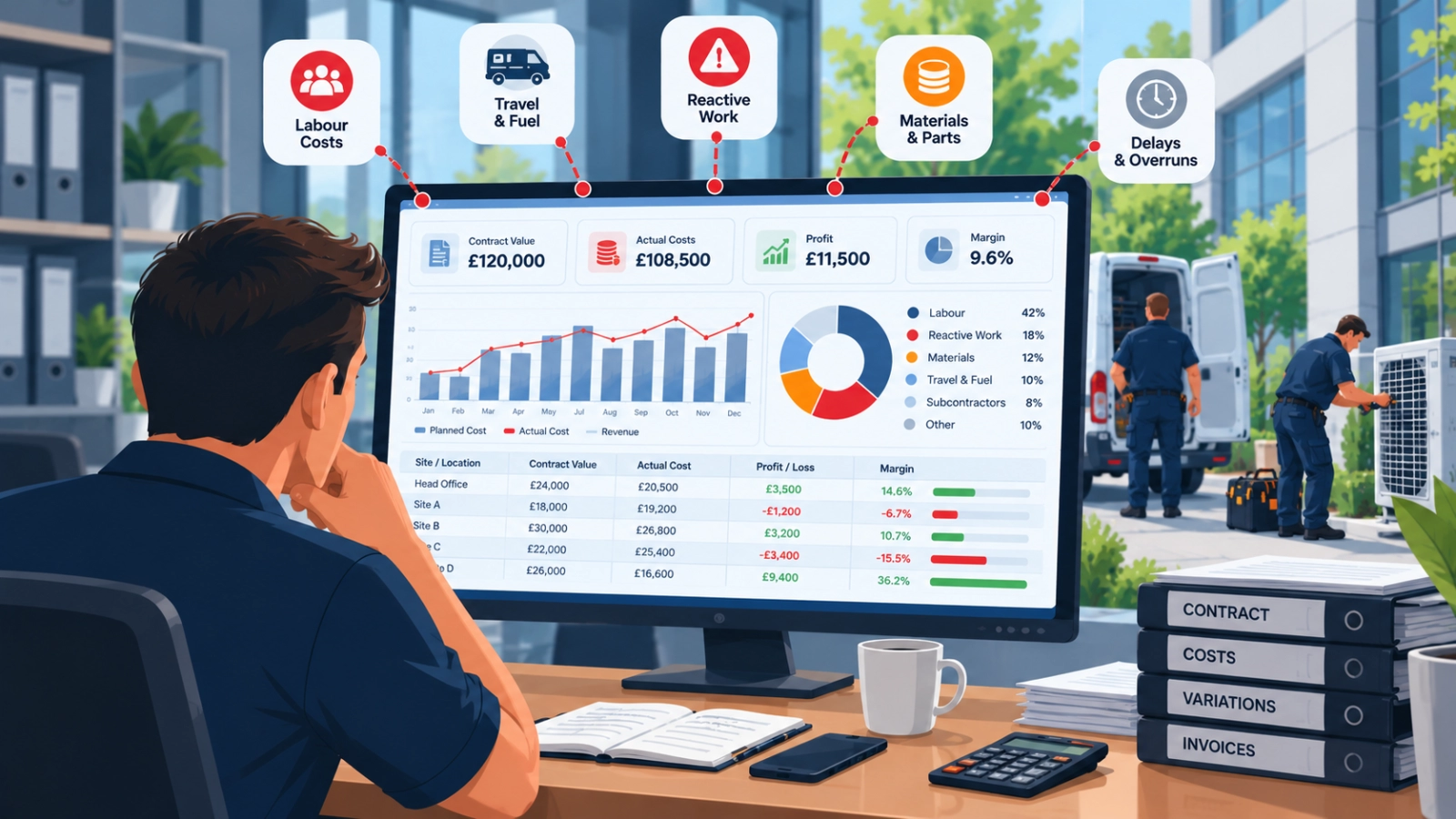
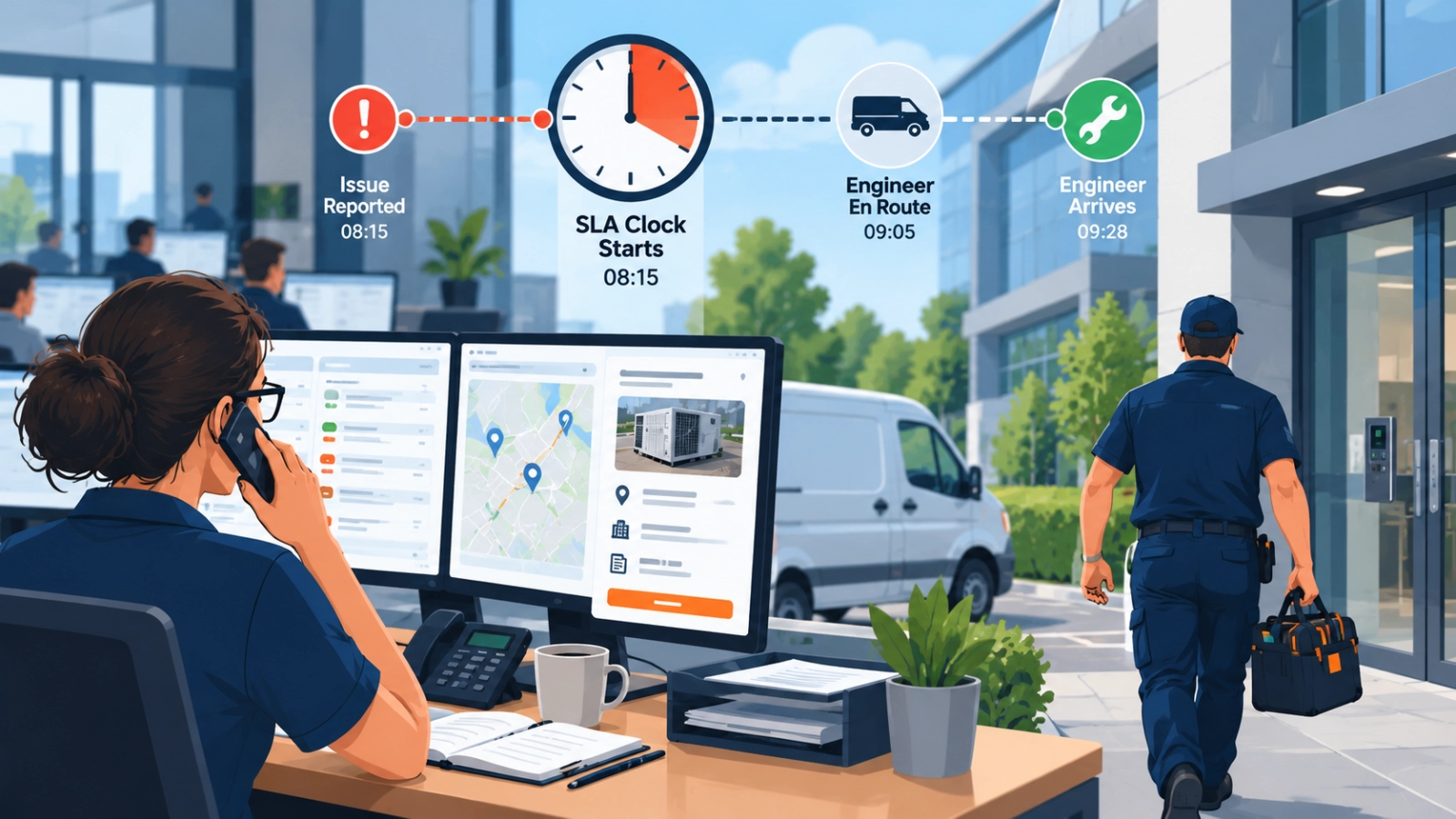
A multi-site FM contract can look healthy from a distance.
The headline shows that revenue is ahead of delivery cost. The contract is making money overall. That should be good news.
But the total may be hiding a more difficult picture.
One site may be performing strongly. Another may require significantly more labour than expected. A third may create repeated reactive work. One service category may overrun. Subcontractor expenditure may be higher than allowed for. Materials may be recorded after the work instead of with it. Additional work may be completed without a consistent commercial route.
The contract can still make money. It can also contain work that is steadily reducing margin, absorbing management time and creating a problem for the next renewal or tender.
A contract-level profit figure is a result. It is not a diagnosis.
The useful question is not only whether the contract is profitable. It is where that result is coming from, where it is changing and whether the business can see the change while there is still time to act.
Contract profitability needs more than one level of visibility
An overall contract figure is necessary. It is not enough on its own.
For an FM provider, profitability becomes more useful when the business can move through the result at several connected levels:
Contract → Site → Job/work order → Cost/activity
At contract level, the business can see whether the overall commercial outcome is still tracking against the expectation built into the price and delivery plan.
At site level, it can see whether a particular location is consuming disproportionate labour, materials, subcontractor resource, travel or reactive capacity. One site may be commercially strong enough to offset another for a period. That does not mean the weaker site can be ignored.
At job or work-order level, the business can identify which visits, job types, activities or customer requests repeatedly use more resource than expected. This is often where the operational reason behind a margin issue begins to emerge.
At cost/activity level, the team can examine what is driving the result: labour, materials, subcontractor expenditure, travel, rework, reactive demand, an uncharged change, an inaccurate original allowance or another delivery issue.
The first three levels show where commercial performance is changing. The final level helps explain why.
The exact measurement method will vary by contract, pricing model, cost policy and management-reporting approach. The practical discipline is to compare the relevant expected allowance with actual and committed delivery cost in a way that can be acted on during the contract, not reconstructed after it has finished.
Expected versus actual is a live delivery question
Expected margin is not only a number set when a contract is priced. It is the commercial expectation against which day-to-day delivery can be assessed.
At job or project level, that expectation may include the revenue or allowance attached to the work and the planned labour, time, materials, subcontractor input, travel or other relevant delivery cost. The detail will differ by service and contract. The important point is that the business understands what it expected the work to require before delivery began.
Actual performance becomes visible as work progresses. Labour/time is recorded. Materials are used. A subcontractor is instructed or invoiced. Travel or other delivery activity is incurred. A reactive visit changes the resource plan. A job expands beyond what was initially understood.
The management question is therefore not simply, “Did this job eventually make or lose money?” It is:
At what point did actual delivery begin moving away from what was expected, and could we see it while there was still time to act?
This is why expected-versus-actual visibility is operational, not merely financial. It helps management identify the moment at which a job’s delivery pattern stopped looking like the original plan.
A job/work-order view can show that early movement. The pattern can then roll upwards into a site view and an overall contract view. That allows the business to distinguish between a profitable contract containing a small number of weak jobs or sites and a wider problem affecting the whole delivery model.
Without this progression, the overall margin can mask the difference between an isolated exception and an underlying contract-wide issue.
An overrun is not a diagnosis
Knowing that labour exceeded expectation tells management that something moved. It does not explain what to change.
Consider a site that appears labour-heavy. The original allowance may have been wrong. Productivity may be lower than expected. The route may involve more travel than assumed. Access arrangements may be causing engineers to wait or return. A recurring asset fault may be creating repeat visits. Customer requests may be expanding the practical scope of the work. A job may have been allocated to the wrong resource. The business may be completing additional activity without a commercial route.
Each explanation points to a different response.
If the original allowance was wrong, the learning belongs in future pricing, renewal preparation or the next tender. If access is the problem, the business may need a customer conversation or a different scheduling process. If the job is repeatedly reactive, the issue may be asset history, planned maintenance, scope or the resource model. If additional work is being carried out without approval, the problem is commercial control rather than engineer productivity.
Treating every overrun as a generic cost problem makes it harder to solve.
A useful commercial review should therefore ask:
- What did we expect this work to require?
- What is actually being consumed?
- What changed the delivery pattern?
- Is this a single exception or a repeating condition?
- Who can change the next outcome?
The result is not simply a better report. It is a more specific management action.
Variations and additional work need a commercial path
FM contracts change in real delivery.
A customer may request an additional task. A site condition may expose work outside the original scope. An asset issue may require a specialist response. A routine visit may identify a problem that cannot be resolved inside the original allowance. Work may need to be performed before the customer can consider the commercial position.
Additional work is not automatically a margin problem. It becomes one when the business does not identify, record, assess, approve, price or recover the commercial consequence in time.
A dependable process gives potential change a clear path:
- Identify what has changed and why.
- Record the relevant operational context, including work, site, customer and cost/time implications.
- Assess whether the work is within the agreed scope or needs a different commercial route.
- Obtain the appropriate authority, customer agreement or internal decision under the relevant contract.
- Make sure completed work, cost and outcome remain visible in operational and commercial reporting.
The applicable contract determines what is included, chargeable, authorised and recoverable. This article does not provide contractual or legal interpretation. The operational principle is that scope, time and cost changes need to be controlled rather than left in informal messages or remembered after the work is complete.
Government Commercial Agency guidance says that contract changes, including scope variations and timescale amendments, should be anticipated, regularly reviewed and agreed in writing.2 RICS change-control guidance similarly addresses work outside scope, evaluating and valuing changes, responsibility, authority and reporting.3
The practical lesson for an FM provider is clear: if a change becomes visible only after the cost has been incurred and the work is complete, the business has fewer options to manage the result.
Timing turns reporting into management control
A year-end or end-of-contract figure can prove whether the contract made money. It cannot change the labour already spent, the subcontractor cost already committed or the additional work already completed without approval.
Timing is what turns profitability reporting into management control.
The questions need to be asked while delivery is still live:
- When did a site start using more resource than its allowance?
- When did a job type begin to overrun repeatedly?
- When did reactive activity become a pattern rather than an exception?
- When did an additional request become work that needed a commercial decision?
- When did actual delivery cost stop tracking with what was expected?
- When did the team have enough information to intervene?
The earlier the movement is visible, the more choices the business has. It may change the delivery approach, seek customer clarification, obtain approval, allocate a different resource, recover the appropriate cost, adjust future scheduling, investigate a recurring issue or prepare a better renewal conversation.
The Government Project Delivery Function advises managing contract performance through accurate and timely reporting, and raising risks and issues early so under-performance can be managed.1 The setting is public-sector project delivery, but the management principle holds for FM providers: information discovered after the commercial outcome is fixed cannot improve that outcome.
Operational information is commercial information
Margin control depends on the information created during delivery.
Time, materials, subcontractor activity, job notes, site exceptions, follow-up work, customer approvals and work-completion records can look like operational detail. They are also the information that allows the business to understand the commercial result of a job.
If time or materials are recorded late, the cost view is late. If a site exception does not reach the contract manager, a scope issue may not be addressed. If follow-on work is not visible, a potential variation can be completed before it has a commercial path. If a completed visit cannot be retrieved, finance and the client may not have the same account of what was delivered.
This is why commercial reporting cannot be reliably bolted on after delivery. It depends on operational information being captured, connected and made available as the work happens. The Job Is Done. The Information Often Isn’t. explores the field-to-office handover that makes this information usable across operations, customer communication and finance.
Reactive work can change the commercial model of a contract
Reactive work has an immediate delivery cost. It can also change the cost of the work it displaces.
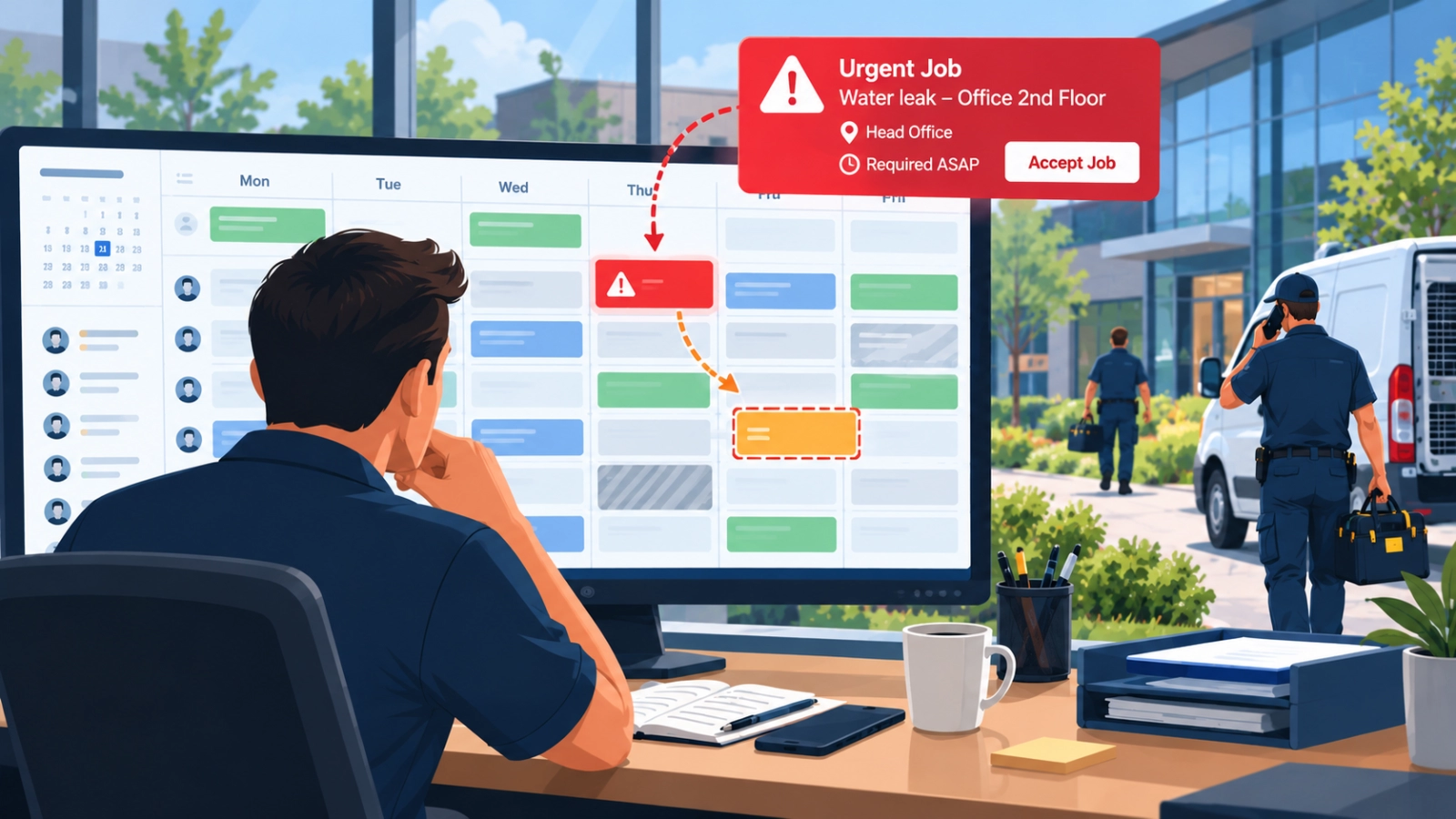
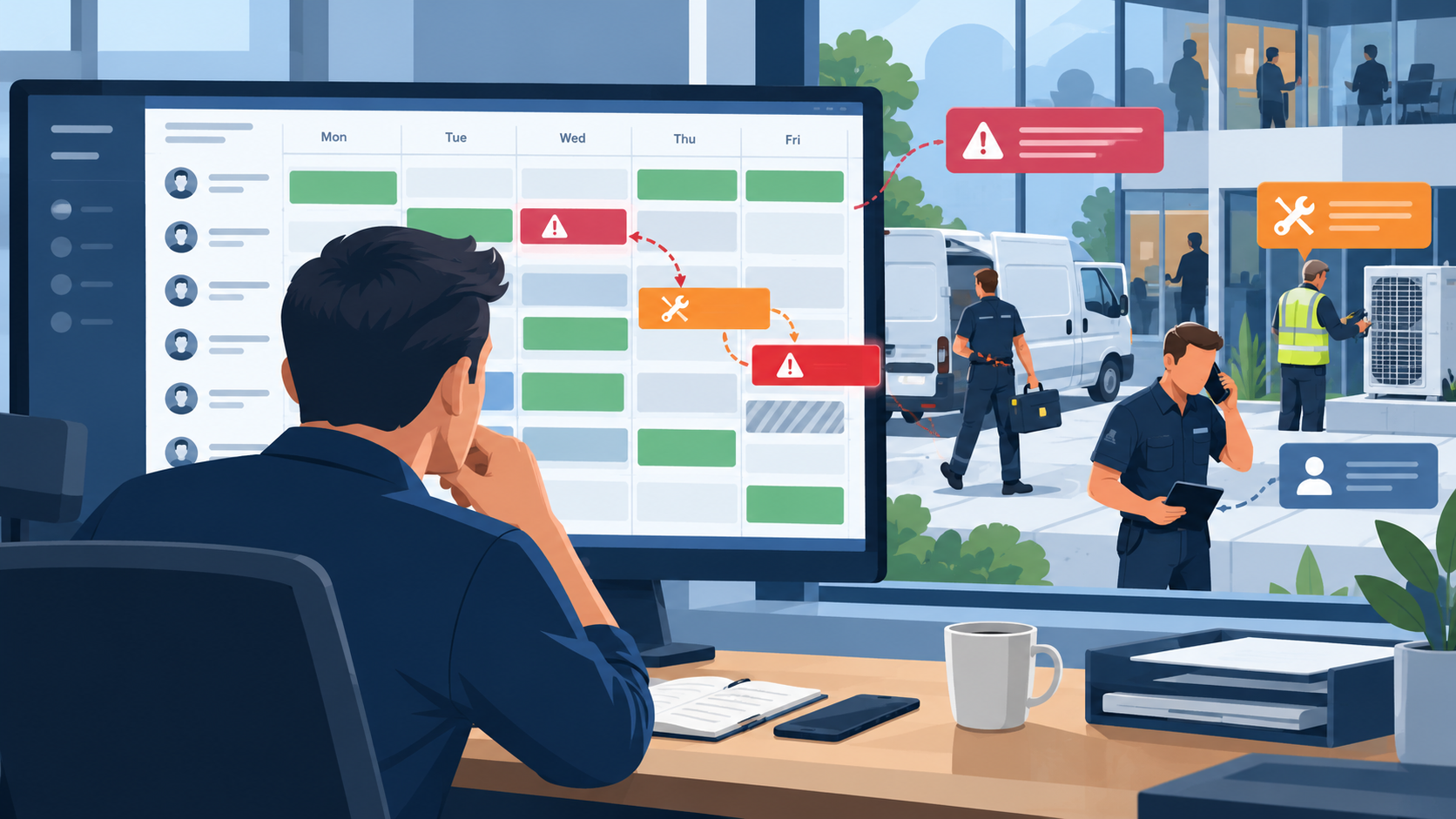
An urgent job may require an engineer to leave a planned visit, change travel, use overtime, involve a subcontractor or push an existing commitment into another day. Repeated reactive interruption can change the actual resource requirement of a contract even when the headline contract revenue does not change.
A contract-level margin figure may show that something has shifted. Job, site and cost/activity visibility helps management determine whether the driver is recurring reactive demand, a capacity decision, an inaccurate allowance, a scope issue or another problem.
The operational control of that capacity trade-off matters as much as the eventual cost. When an Urgent Job Arrives, Something Else Has to Move explains why displaced work must remain visible with an owner, new date and next action rather than disappear into a future calendar.
Use the learning while it can improve the next decision
The value of commercial visibility does not stop at identifying a weak job or site.
It should inform the current contract review: where delivery needs to change, where a customer conversation is required, whether further cost needs to be controlled and which recurring conditions need investigation.
It should also improve the next commercial decision. The business can use the information in renewal discussions, future pricing, tender assumptions, mobilisation planning, subcontractor strategy and resource planning. It can decide which types of sites, services or contracts it wants more of and which need a different model before they are repeated.
The purpose is not to prove, after the fact, that a contract made money. It is to understand where the result came from while the business can still influence delivery and price the next opportunity with better evidence.
Frequently asked questions
Why can an FM contract be profitable overall but still have loss-making work?
A strong site, service category or group of jobs can offset weak performance elsewhere. The contract total may remain positive while labour, reactive demand, subcontractor cost, materials or additional work are reducing margin at a specific site or activity level.
What information helps an FM provider control contract margin?
The exact requirements vary by contract, but management typically needs current visibility of expected versus actual delivery performance, relevant labour/time, materials, subcontractor cost, reactive activity, additional work, changes in scope, customer approvals and invoicing status at contract, site and job level.
Why is late cost capture a contract-margin problem?
If costs arrive after the work has been completed or the reporting period has passed, the business may believe the margin is stronger than it is. Late information reduces the opportunity to clarify scope, obtain approval, alter delivery or manage the commercial outcome while action is still possible.
How CQ supports live margin visibility
CQ supports the operational approach described in this article by connecting jobs, sites, customer records, labour/time, materials, subcontractor information, costs and invoicing context. At job or project level, it provides expected-versus-actual profitability visibility, connecting the commercial expectation with actual delivery costs as work progresses. That information can then contribute to wider visibility across sites, customers and contracts rather than being reconstructed from disconnected systems. CQ’s existing FM contract management and SLA compliance guide provides related detail on contractual obligations, evidence and delivery performance.
A contract is not commercially understood when its total margin is known. It is understood when the business can see the sites, jobs and delivery decisions creating that result early enough to change what happens next. If disconnected tools are making that visibility difficult as the operation grows, CQ’s guide on how to choose job management software when scaling offers a broader decision framework. Explore CQ's FM Business Management Software to see how connected operational and commercial information can support that control, or book a CQ demo to discuss it in the context of your own FM contracts.