The schedule is full.
Engineers are committed to PPM visits, routine maintenance, contractual schedules and customer appointments. The day has been planned around skills, travel, site access and the work already promised.
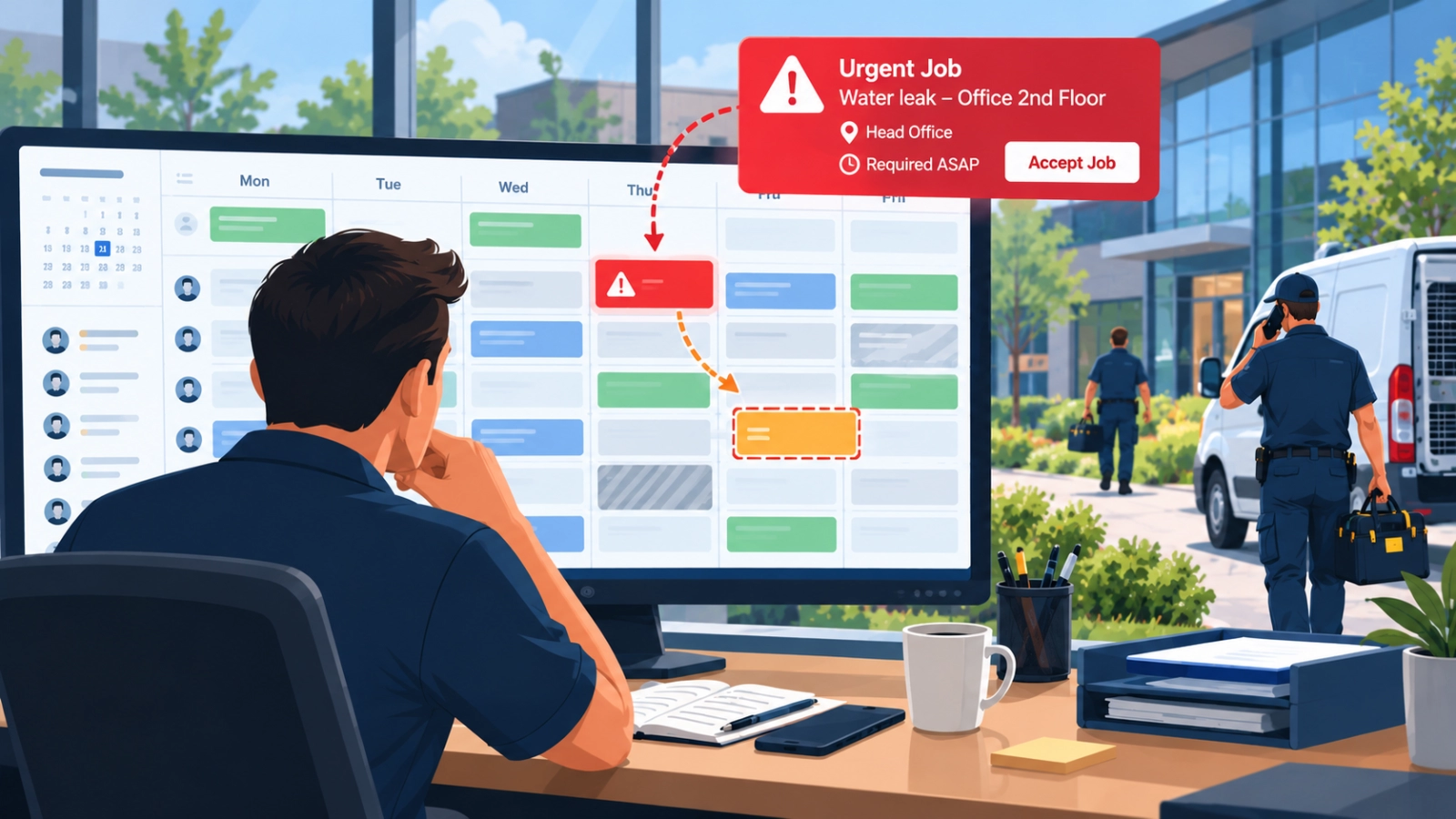
Then an urgent reactive job arrives.
It may be a breakdown, a safety issue, an SLA-controlled request or an unexpected customer problem that genuinely needs an immediate response. Someone may need to attend. The reactive job may be the right priority.
But it does not create additional capacity.
If an engineer is reassigned to the urgent job, something already planned is likely to move. The operational question is not only “Who can go?” It is also:
What changes if they go, what commitment is displaced, and can the business see the consequence before it becomes tomorrow’s problem?
Good FM scheduling is not about creating a perfect plan that never changes. It is about being able to change the plan intelligently when reality changes.
Planned and reactive work compete for the same capacity
Planned and reactive work have different purposes.
Planned or preventive maintenance is arranged in advance to help avoid failure, reduce disruption and meet recurring service commitments. Reactive maintenance responds after an asset fails or an issue occurs.1
In day-to-day FM operations, however, both types of work compete for the same practical resources:
- engineers with the required skills and competencies;
- travel time and geographic coverage;
- access windows and customer availability;
- time remaining in the working day;
- specialist suppliers or equipment; and
- operational attention from schedulers, supervisors and contract managers.
That makes the schedule a shared-capacity plan, not a list of independent appointments.
A PPM visit may have been placed at a specific time because a site is accessible only then. A routine job may require a particular competence. A customer appointment may already have been confirmed. A planned visit may be linked to a contractual frequency or an obligation that cannot simply be forgotten because something more urgent has arrived.
Reactive work can still need to take priority. The point is not to protect the original plan at all costs. It is to understand what will change when the plan changes.
The decision is bigger than finding the nearest engineer
When an urgent job arrives, the nearest or apparently available engineer may not be the correct operational answer.
A scheduler needs to understand the new request: its urgency, its service requirement, the relevant skill, site location, access needs and, where applicable, the SLA commitment. They also need to understand the existing workload of every possible person who could attend.
That means seeing more than empty space in a calendar. The decision needs to show both sides of the trade-off:
- The requirement of the urgent job — what needs to happen, by when, with which skill and under what service commitment.
- The consequence for the work already committed — which jobs will move, what obligation they represent, who is affected and what must happen next.
Before reallocating capacity, operations should be able to establish:
- the priority and relevant SLA requirement of the new job;
- which engineers have the right skills, location and practical availability;
- what each possible engineer is currently scheduled to do;
- which planned commitment would be displaced by each allocation option;
- whether another engineer, supervisor or specialist supplier could cover either job;
- whether moving the planned work creates a contractual, customer, safety or service consequence; and
- who will own the new date, communication and follow-up for the displaced job.
This is the difference between dispatching a person quickly and reallocating capacity intelligently.
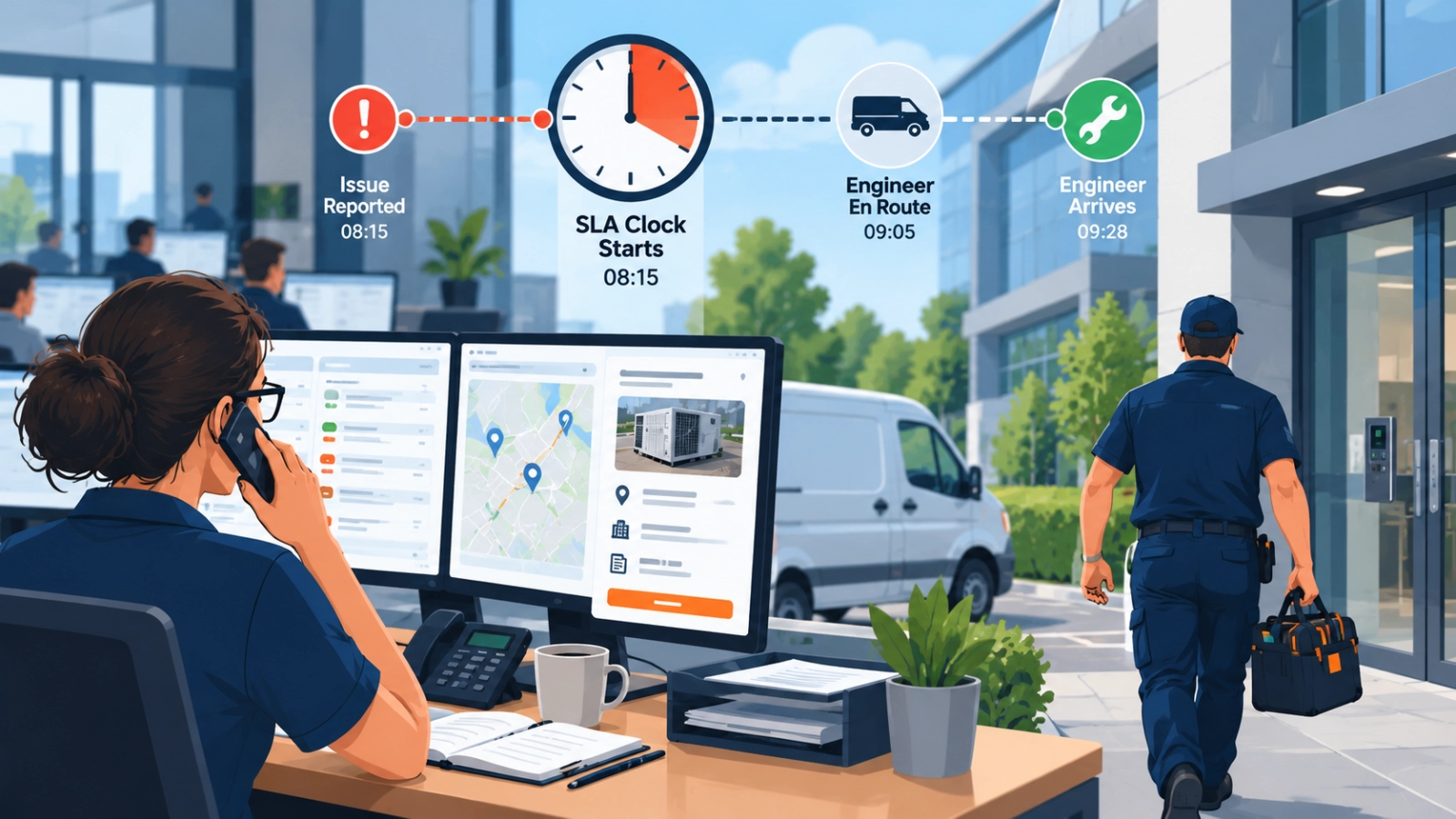
For SLA-controlled reactive jobs, the scheduler also needs to see whether a proposed response can still be made inside the relevant service window. The team should not discover that a job was scheduled outside the commitment after the schedule has already been changed. As explored in The SLA Clock Starts Before the Engineer Arrives, live SLA information matters because it gives the team a chance to intervene while the work is still open.
Moving a planned job is a decision, not an administrative edit
A moved PPM visit is still a commitment.
It may be right to move it. The urgent job may make that unavoidable. But moving an appointment to a later day should not make the original obligation disappear from view.
A controlled re-planning decision needs to make the following clear:
- What has moved? The service, site, asset, customer and original commitment should remain identifiable.
- Why has it moved? The reason may be an urgent reactive job, access issue, resource problem, customer request or another recorded exception.
- What is the new date and is it appropriate? The team needs to understand whether the new date remains acceptable for the contract, service need and customer arrangement.
- What does the new date affect? Moving a visit may create a fresh clash with another planned job, access window or engineer commitment.
- Who owns the next action? Someone needs to be accountable for ensuring the visit happens, rather than assuming the calendar move has solved the problem.
- Does the customer need to know? If the change affects a customer appointment, access arrangement or service expectation, communication belongs inside the re-planning decision.
The useful term is displaced work.
It describes the real consequence of reallocating capacity. The work has not vanished; it has been displaced by a higher-priority demand. That distinction helps prevent vague language such as “we will pick it up later” from hiding a live service obligation.
The real risk is the chain of displaced work
Moving one planned visit can solve the immediate problem. It does not necessarily solve the planning problem.
A PPM visit moved from today may appear in tomorrow’s schedule. If tomorrow is already full, something else may move. A further urgent request may arrive. An access window may be missed. The original visit may move again.
Over time, an operation can create a chain of displaced work:
- a PPM backlog that is visible only when the reporting period ends;
- repeated rescheduling and avoidable administration;
- customer dissatisfaction when appointments are moved more than once or updates arrive late;
- new service pressure on work that was originally planned well in advance;
- overtime or costly capacity decisions used to recover the plan; and
- firefighting becoming a normal operating pattern rather than an exception.
The University of Michigan’s published maintenance approach provides a useful operating example. Its planning-and-scheduling process separates same-day response work from scheduled work, uses staff who are not fully scheduled for urgent response, and gives rescheduled incomplete preventive work an explicit place in the scheduling queue.2
That is not a template every UK FM provider should copy. Different contracts, team structures and service models require different approaches. The important principle is that urgent work, planned work and rescheduled work need a visible priority and review process. Otherwise, the schedule changes but the backlog is created out of sight.
Make the trade-off visible at the point capacity is reallocated
The most important scheduling moment is often the point at which someone decides to move an engineer from work already committed to a new urgent request.
A good operational view should help the scheduler see the urgent requirement and the planned consequence together.
For the reactive job, that includes the priority, remaining service window, required skills, location and next available options. For the candidate engineer, it includes the existing scheduled workload, the customer/site commitments that will be affected, and the job that will become displaced if the allocation changes.
This gives the scheduler a meaningful choice. They may still decide that the reactive job must take priority. But the decision is then made with visibility of what it will displace rather than on the assumption that an engineer can be “freed up” without consequence.
The following questions make that decision more robust:
- Can the urgent job be allocated inside its relevant service commitment?
- Which engineer can attend with the least harmful impact on already-promised work?
- Is another skilled person, supplier or supervisor a better option?
- Which job moves if this person is reassigned?
- Can the displaced job be placed on a new date without creating another failure or customer problem?
- Does the customer need an update before the change becomes a missed expectation?
- Who owns the displaced work until it is completed?
The result is not a fixed schedule. It is a schedule that can absorb reality without losing control of the commitments it changes.
Protect planned commitments without denying operational reality
A strong FM operation does not pretend that urgent work will never interrupt planned work. It creates controls that make those interruptions deliberate, visible and manageable.
1. Use clear priority rules
The team needs a contract- and risk-aware understanding of what genuinely warrants interruption. That is not the same as a rigid universal rule. It means the decision should not depend only on who calls most loudly or who happens to reach the scheduler first.
The relevant factors may include safety, business continuity, customer impact, contractual requirements, the SLA commitment, asset/service context and the realistic availability of a suitable response.
2. Keep a visible displaced-work queue
Every moved job should remain visible with its original commitment, reason for movement, current owner, new planned date and next review point. This allows the business to distinguish a one-off re-plan from a growing pattern of deferrals.
The queue should not be a place where work is stored indefinitely. It is a management view of commitments that need a new decision and continued attention.
3. Review capacity and consequence before changing the plan
Before a job moves, consider the people, skills, travel, access and existing work that will be affected. The reactive job may still need to take priority. The operation should know whether it is creating a manageable adjustment or shifting a bigger problem into the next day, week or customer relationship.
4. Treat customer communication as part of the decision
If moving planned work changes an appointment, access arrangement or agreed service expectation, the customer communication should not be left until later. It belongs in the re-planning process, alongside the new date and owner.
A customer is more likely to accept a necessary change when it is communicated clearly and early than when they discover it through an unexplained missed visit.
Review the pattern, not only the urgent job
One urgent call-out does not necessarily signal an operational problem. FM involves unexpected events. The more useful management question is whether the same disruption is happening repeatedly.
Reviewing the pattern can reveal whether reactive demand is causing a capacity issue that needs a different response.
Useful questions include:
- Which reactive job types are repeatedly displacing planned work?
- Are particular sites, assets, services or customers generating more urgent demand?
- Are planned jobs being moved because of genuine emergencies, poor initial planning, access failures, skill shortages or limited usable capacity visibility?
- Which planned commitments are being deferred more than once?
- Are customer updates happening early enough when visits need to move?
- Does the volume of reactive interruption require a different resource plan, supplier arrangement, service discussion or future contract assumption?
Reliable job records matter here. If the reason for an exception, incomplete visit or follow-up exists only in a message thread or one person’s memory, the business cannot easily see the pattern behind its schedule disruption. The Job Is Done. The Information Often Isn’t. explains why meaningful field information needs to become a usable record for the next operational decision.
The same applies to the PPM programme. A recurring maintenance schedule needs more than calendar dates; it needs visibility of actual completion, exceptions, access and capacity. When the PPM Plan Meets the Working Day explores that wider challenge of keeping planned commitments deliverable at scale.
A backlog figure is an outcome. The useful management question is what repeatedly creates it.
Reactive control and planned-work control need to work together
A disciplined reactive workflow still matters. The urgent job needs correct triage, suitable allocation, clear status, evidence and communication. CQ’s existing guide to managing reactive FM work covers that side of the operation.
But the work displaced by that response needs the same level of control.
If a reactive job is handled perfectly while the PPM visit it displaced is silently moved into an already-full future day, the operation has only solved half the problem. It has protected the immediate response but left a new commitment exposed.
The aim is not to make planned and reactive work compete for attention. It is to give both parts of the operation a shared view of capacity, commitments and consequences.
How CQ supports visible capacity decisions
CQ supports this operational approach by bringing connected scheduling, live job status, SLA information and field updates into the same working view.
When a reactive decision is being made, operations can understand both sides of the trade-off: the current requirement of the urgent job and the work already committed to the relevant engineers. This makes it easier to identify which jobs will become displaced, keep those commitments visible and give them a clear owner, new date and customer communication where needed.
For SLA-controlled work, CQ can visually show available scheduling periods in green where the proposed response remains within the relevant SLA window, and red where it would fall outside it. If the scheduler deliberately places the work outside the SLA window, that decision must be actively acknowledged before proceeding.
The point is not the colour itself. It is that the operational consequence is visible while the scheduling decision is still being made. The scheduler can see both the service commitment of the urgent job and the planned commitments affected by reallocating capacity.
CQ does not remove the need for judgement. It supports better judgement by making the context of the decision easier to see and act on.
An urgent job may change the plan. It should not make work disappear.
Reactive FM work will always be part of service delivery. Sometimes it must interrupt the plan.
What matters is whether the business can respond to the urgent requirement without losing sight of the work it has displaced.
A controlled operation makes the trade-off visible. It shows the relevant service commitment, the actual capacity available, the planned work that will move, the new action required and the person who owns it. It then reviews whether repeated interruption is creating a pattern that needs a wider operational response.
An urgent job may change the plan. A controlled operation makes sure it does not make the displaced work disappear.
If your business is assessing whether its current systems can support this level of connected operational control, CQ’s guide on how to choose job management software when scaling offers a broader decision framework. To see how CQ connects scheduling, jobs, field updates, customer communication and financial visibility in one system, explore CQ's FM Business Management Software.
To see how CQ could help your FM team make capacity decisions with clearer visibility of the work they affect, book a CQ demo.
Frequently asked questions
Should reactive FM work always take priority over planned work?
No universal rule applies. Some urgent or safety-critical jobs must take priority, while other requests can be scheduled around existing commitments. The key is to make the decision using the relevant contract, risk, SLA, customer impact and available capacity — and to keep any displaced work visible.
What should happen to planned work moved for a reactive job?
The moved job should retain its original context and show why it moved, who owns the next action, its new planned date, whether the customer must be updated and any consequence for other work. It should be reviewed as visible displaced work, not simply moved to a later calendar slot.
Why does reactive work create a maintenance backlog?
Backlog can develop when urgent work repeatedly takes the capacity assigned to planned commitments and the displaced work is pushed into already-full future days. The business needs visibility of both the reactive demand and the planned work it has moved to prevent deferrals becoming normal.