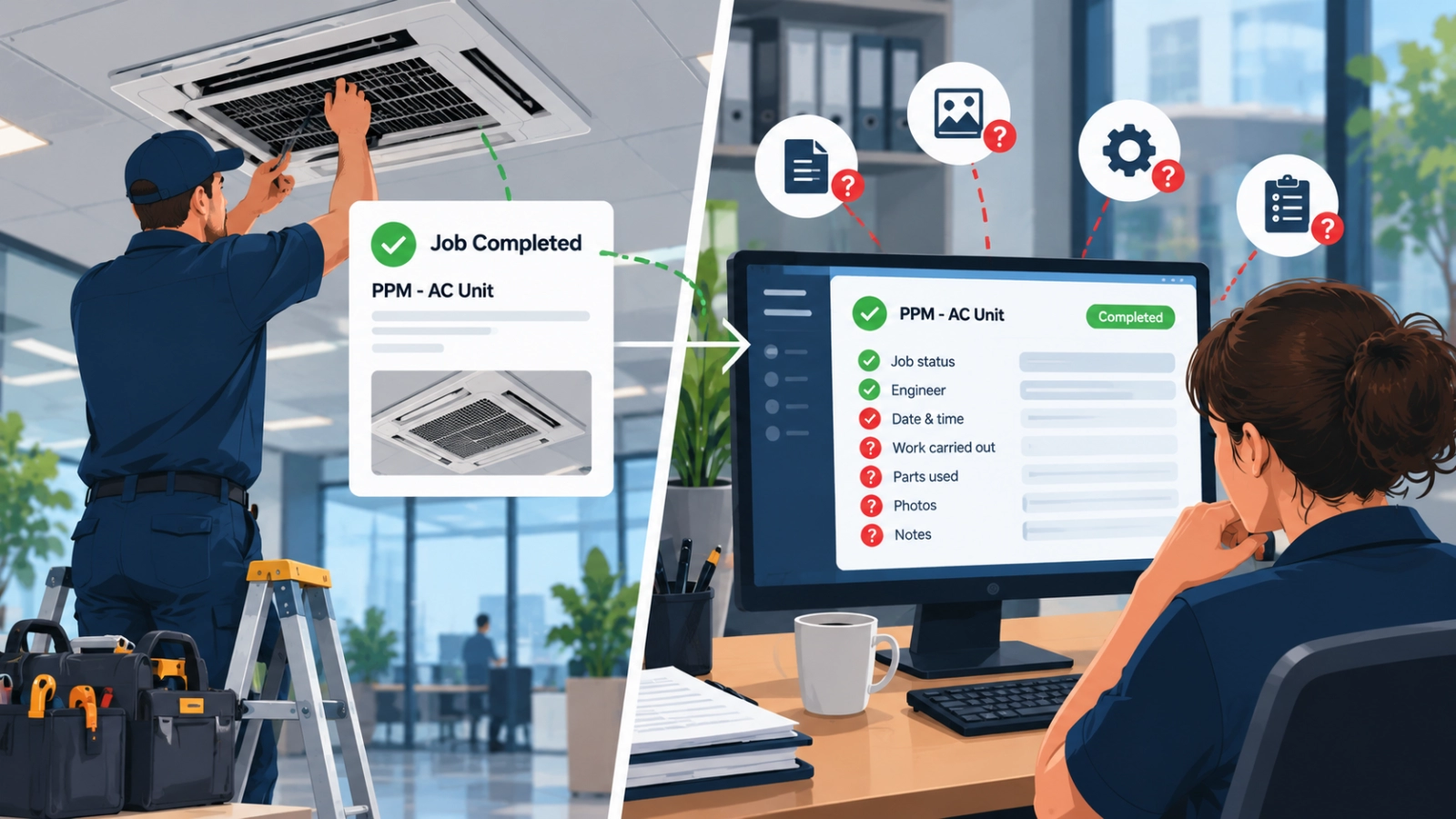
An engineer has attended site and completed the physical work. The office then needs to know what happened.
What exactly was done? How long did it take? Were materials used? Were photographs or readings captured? Was a form completed? Was anything else found? Does the customer need an update? Is further work required? Is the job ready for finance to act on? And, six months later, can anyone find the evidence without calling the engineer who attended?
This is where a completed visit can become a second job for the office.
The engineer may have finished the task. The operational work may not be finished at all.
That is the site-to-office information gap. It is not simply a problem of paper forms or mobile signal. It is the gap between completing physical work and creating the reliable operational record that the rest of the business needs to manage the next decision.
Communication is not the same as shared visibility
Many FM businesses communicate constantly.
Engineers call the office. WhatsApp messages are exchanged. Photographs are emailed. Supervisors receive verbal updates. Forms are completed. Someone may even have all the information needed to understand the job — somewhere.
The problem is that communication does not automatically create shared operational visibility.
A photograph on an individual phone may not show which job, site or asset it relates to. A message saying “sorted” may reassure one person but tell a contract manager nothing about the work completed, the cause of the issue or the next required action. A note might answer a scheduler’s immediate question but provide no information for finance. A verbal update may never become a record that another engineer can retrieve later.
Information can be present and still be unusable.
Good communication helps people make decisions. Chasing information is often the cost of not having visibility.
The aim is not to eliminate conversations. FM work will always require judgement, coordination and direct communication. The aim is to ensure that information created during delivery becomes a dependable record with enough context for the next person to use it.
A completed site visit creates several information needs
One engineer visit can affect several parts of the operation at the same time.
The scheduler needs to know whether the work is genuinely complete, whether follow-up has been raised and whether the rest of the day or week needs to change. The contract manager needs to understand any service exception, recurring issue or client implication. The customer may need a clear update rather than a generic “job closed” notification. Finance needs enough time, material, scope and approval information to capture cost and decide the next invoicing action. The next engineer needs a usable history, not a search through old messages.
A work order is valuable precisely because it can connect these roles. FMX describes work-order management as a lifecycle covering planning, scheduling, assignment, execution, monitoring, reporting, quality assurance and closure. It also identifies the practical context that should stay connected to the work, including scope, location, assigned people, priority, timing, resource requirements, cost estimates and attachments.1
That does not mean every job requires a lengthy record or every person needs to see every field. It means the record needs to be complete enough for each relevant person to act without starting the investigation again.
Microsoft’s field-service work-order model illustrates the same principle in practice: the working record can bring together service account, location, contacts, asset context, booking details, financial information and, after completion, the resolution plus products and services used.2
For an FM provider, the key question is:
Does information from the visit move through the business in a form that lets the next person make the next decision?
Information without context creates a second job for the office
A piece of information is not necessarily useful just because it exists.
A photo without the correct job or asset context can require a call back. A time entry without an explanation of the work may not tell finance whether the activity was within scope. A note that says “follow-up required” is not enough if no one knows what follow-up, who owns it or whether the customer must approve it. A materials record that arrives after the job has been closed can delay cost capture and invoicing.
The office then starts to chase.
- What did you find?
- Did you use any materials?
- Is the job actually finished?
- Did the customer sign anything?
- Is this additional work?
- Do we need to return?
- Which site was this photograph taken at?
None of those questions is unreasonable. But when they are asked repeatedly after a physical visit, they reveal that the operational close-out has not travelled with the job.
A useful completion record does not need to be long. It needs to be complete enough, structured enough and connected enough that the next person does not have to start from the beginning.
Capture the required information as part of doing the work
A major cause of site-to-office chasing is that important information is treated as optional administration after the physical task is complete.
The engineer has finished the repair, service or inspection. The office can ask for the paperwork later. A photograph can be sent when the engineer is back in the van. A materials note can be added at the end of the day. A follow-up can be mentioned in a message if someone remembers.
That approach makes the office responsible for rebuilding the job record after the people closest to the work have moved on.
A stronger operating model captures the information needed to complete the operational record as part of the field workflow itself.
Depending on the job, contract and service process, that could include:
- clocking in and out;
- completing a required form or checklist;
- carrying out a vehicle check;
- adding job notes;
- uploading required photographs;
- recording readings or other evidence;
- recording materials or time; and
- identifying follow-up work, an exception or a customer decision.
Not every job needs every field. A straightforward routine visit may need a lighter close-out than a safety-critical inspection, a complex reactive repair or work that creates a billable variation. The requirements should be appropriate to the job type, contract and operating process.
The principle, however, is consistent: where particular information is required to complete the operational record, it should be captured as part of completing the work — not treated as paperwork to be chased afterwards.
This does not remove the need for supervisors to use judgement. It does reduce the risk that a job appears finished while the essential record remains incomplete. It also improves accuracy because the engineer records the information while the site, asset, work and customer context are still immediate.
A job needs an operational close-out standard
A field visit should not be considered operationally complete simply because the engineer has left site. The business needs a clear definition of what “complete enough to close” means for that job.
The right standard will differ by contract and work type. It may be brief for a simple task and more detailed for a visit involving evidence, compliance requirements, additional work or client approval. But a good close-out process should normally establish the following.
1. What work was completed
The record should state what was done and what outcome was achieved. “Completed” is a status, not an explanation.
2. What time and resources were used
Where relevant, the record needs the labour/time, materials and other resource information required for operational review and financial control.
3. What evidence is required
The job may require photographs, readings, forms, signatures, certificates or another agreed record. The exact requirements depend on the work and applicable contract or compliance context.
4. What could not be completed
Exceptions are operationally important. If the job needs another visit, a specialist resource, customer access, a quotation or a variation approval, that information needs to be clear before the work disappears into a closed status.
5. What the customer needs next
Some visits need no further client action. Others require an update, a recommendation, approval, a quotation or a revised appointment. The correct next step should be visible to the person responsible for customer communication.
6. Whether finance can act
Finance does not need every technical detail. It does need sufficient context to capture costs correctly and decide whether the job can progress to the appropriate invoicing or commercial action.
7. What history the next visit should inherit
The record needs to sit with the relevant job, site, asset or service history so that the next engineer, scheduler or contract manager does not have to recreate the background.
This is not an argument for adding administration for its own sake. It is a way to ensure that the information genuinely required by the next operational step is captured at the point where it is most accurate and easiest to provide.
Storing information is not enough. It has to reach the person who needs to act.
A central record is necessary. It is not always sufficient.
An engineer can submit a form, record an exception, add a note or identify follow-up work. If the relevant office person has to keep checking every job to discover what changed, the business has moved the information but not removed the chasing.
Good site-to-office information flow makes meaningful changes visible to the person who needs to make the next decision.
For example:
- an engineer identifies follow-up work, and the scheduler or operations team is prompted to plan it;
- a site exception affects the service commitment, and the contract manager can review it;
- a customer action or approval is needed, and the right person knows to contact them;
- a job contains information that affects cost recovery, and finance can act on it; or
- a meaningful status change affects the plan, and the team does not continue scheduling from an outdated assumption.
The point is not to create a stream of notifications for every routine update. That simply replaces one form of noise with another. The point is to make action-worthy information reach the appropriate role without relying on someone to remember, regularly check a screen or chase the engineer for confirmation.
This turns the operating model from “store the job information somewhere” into “make sure information that requires a decision reaches the person who can make it.”
Going paperless is not the same as completing the information flow
A paper form turned into a digital form is still only a form.
It can be completed late. It can be saved against the wrong job. It can omit the detail that finance or the client needs. It can remain inaccessible to the team responsible for the next action. It can be stored digitally and still be just as difficult to find six months later.
The useful question is not, “Have we gone paperless?” It is:
Can information generated on site travel through the operational chain to everyone who needs it, without being repeatedly recreated, re-keyed or chased?
A dependable flow looks like this:
- the engineer sees the relevant job and site history before attending;
- information captured on site remains connected to the correct job, site, asset or service context;
- operations sees completion status and any follow-up required;
- contract management can understand service exceptions and emerging patterns;
- the client receives the right update at the right point;
- finance receives the commercial information needed to act; and
- the next visit begins with the record created by the previous one.
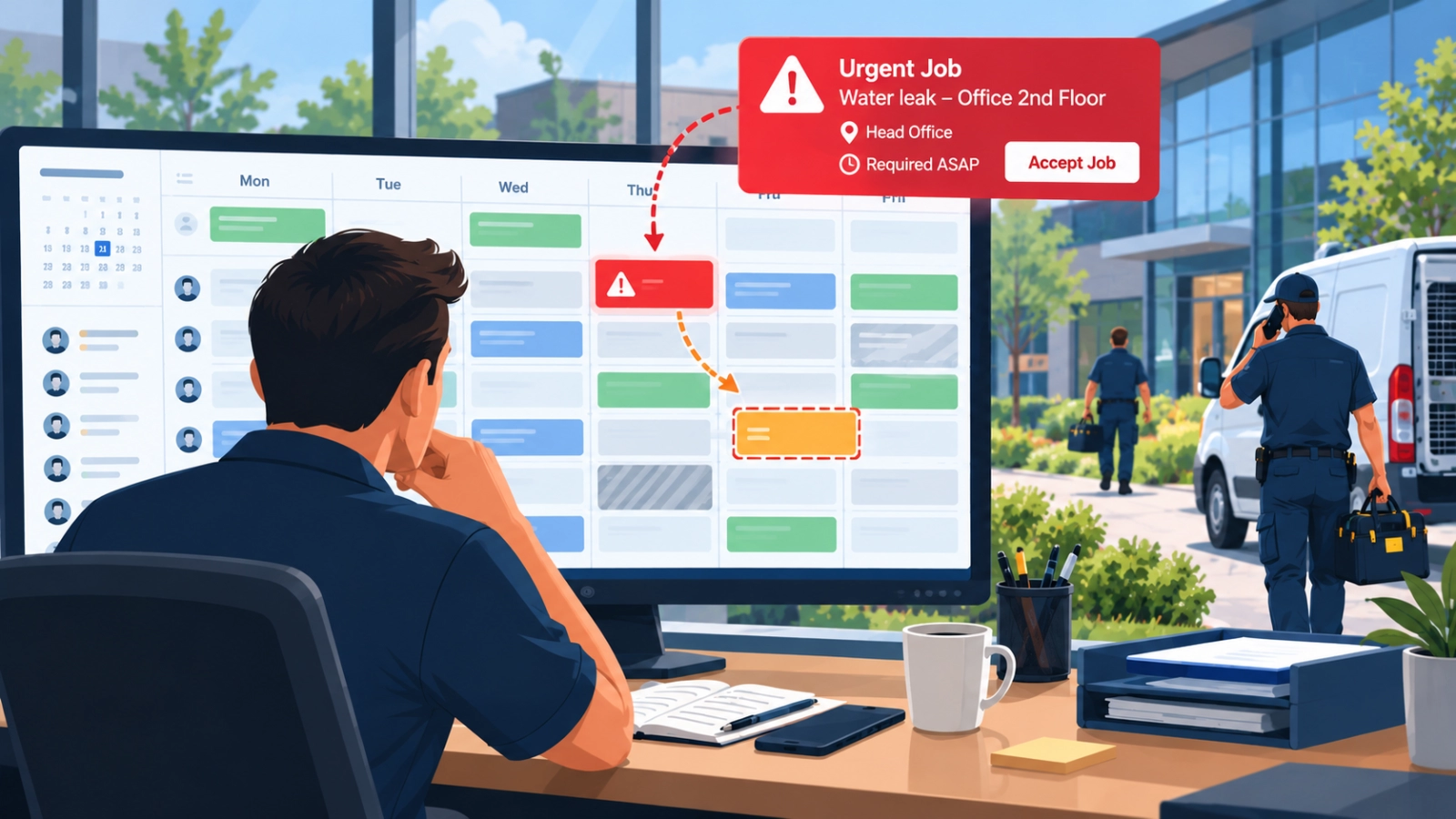
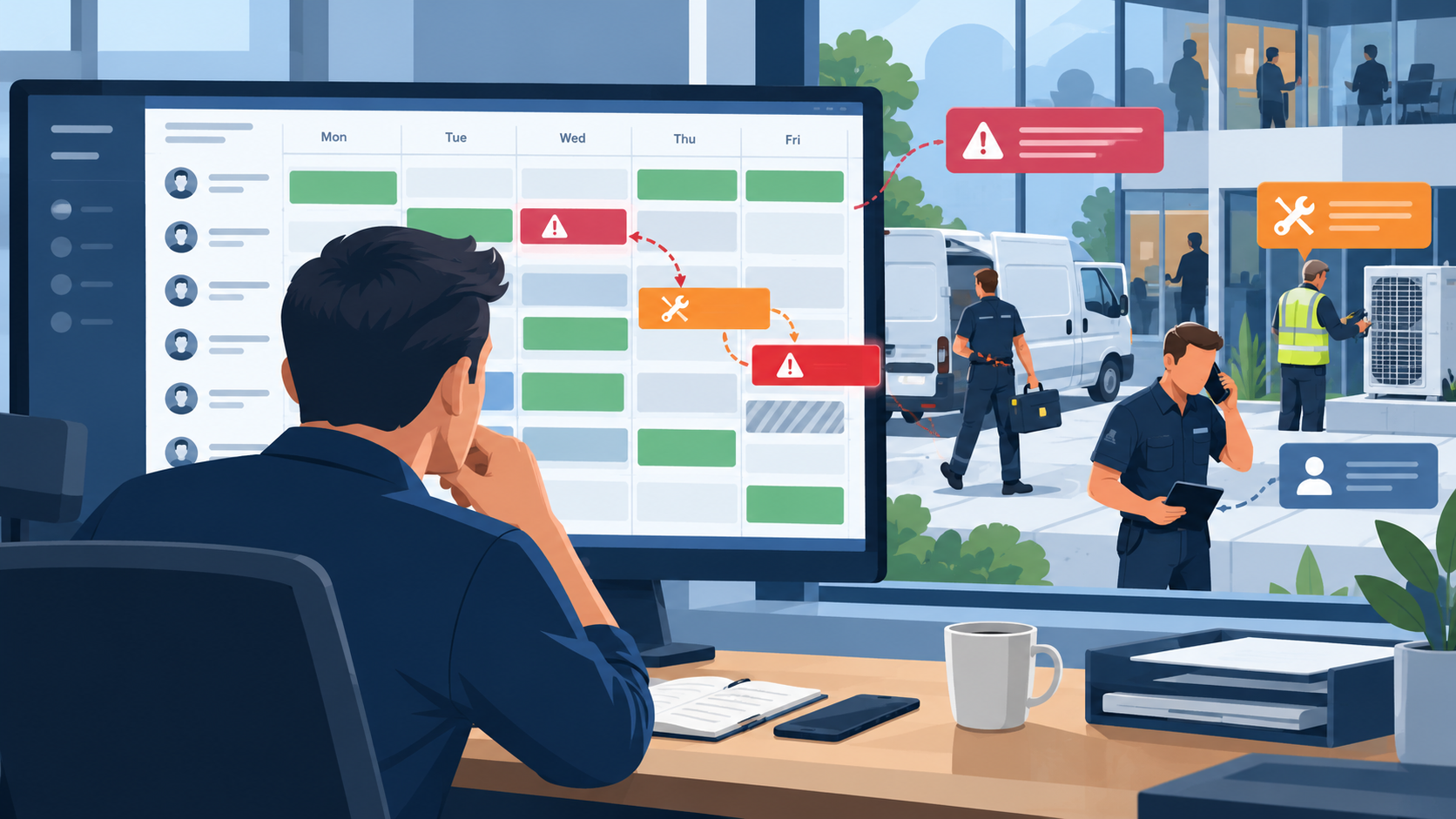
Reliable completion information also affects the wider schedule. If a visit is incomplete, moved or has created follow-up work, that should feed into the plan rather than remain in a message thread. That is particularly important in a large recurring programme, where one incomplete visit can affect later capacity and commitments. See When the PPM Plan Meets the Working Day for the wider scheduling consequence.
Historical retrieval turns field information into an operational asset
The value of a good record becomes obvious when someone needs it months later.
A customer may question a visit. A recurring fault may return. An invoice may be challenged. A new engineer may attend the same site. A contract manager may need to understand why a service pattern changed. The person who completed the original work may no longer be available.
If information is spread across messages, personal devices and memory, the business has to reconstruct the event from fragments. That takes time, creates uncertainty and can make a routine question feel like an investigation.
A retrievable history should make it possible to identify:
- what was requested and why;
- what happened during the visit;
- when it happened and who carried it out;
- what evidence was collected;
- what was found, deferred or recommended;
- what the client was told; and
- what subsequent work occurred.
Specific contractual, statutory and compliance obligations will determine the evidence and retention requirements for particular work. HSE guidance, for example, requires results of certain work-equipment inspections to be recorded and retained at least until the next inspection.3 That is not a universal retention rule for every FM job. The broader operational lesson is that information is far more valuable when it forms a retrievable history rather than disappearing into conversations.
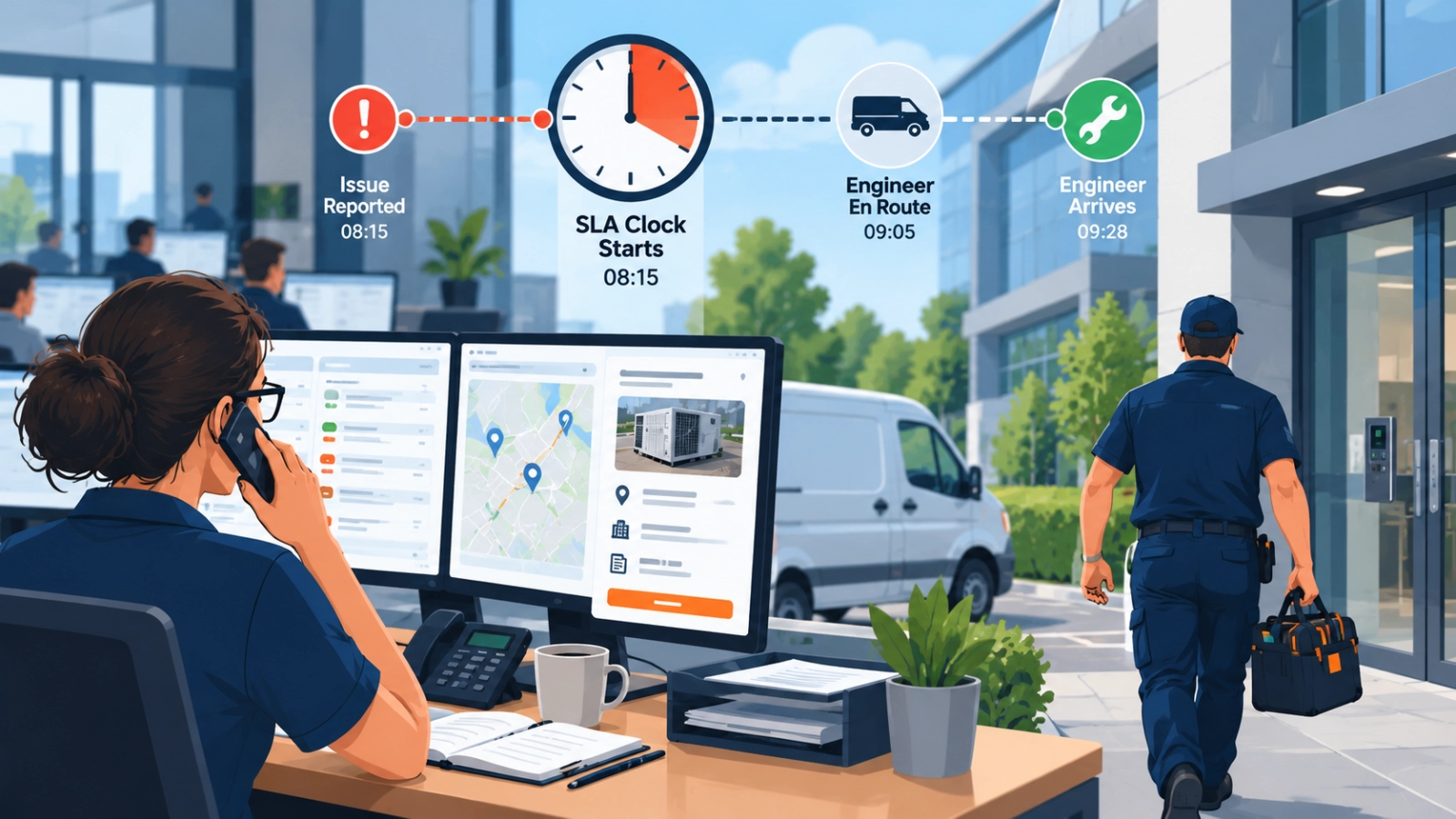
This historical record also supports SLA performance. A service commitment is much easier to explain when the chronology of request, action, attendance, exception and completion is visible as work happens. See The SLA Clock Starts Before the Engineer Arrives for the wider operational controls behind that timeline.
Chasing is a management cost, not a minor inconvenience
Every missing detail creates another job.
Someone phones the engineer. Someone searches an email chain. Someone asks which material was used. Someone requests a photograph. Someone holds the invoice because the commercial context is unclear. Someone contacts the customer without being certain what happened on site.
That effort is rarely recorded as a line item. It appears as slower close-out, delayed reporting, postponed invoicing, repeated interruptions for engineers and management time spent rebuilding the context that should have moved with the job.
In conversations with service businesses, CQ often sees office teams spend time chasing information that has already been created somewhere else but has not reached the right person in a usable form.
The issue is not that people are failing to communicate. It is that the operation has made people responsible for manually carrying context between systems and teams.
How CQ supports a complete operational record
CQ is designed to support the operating principles above without making the article’s point dependent on a feature list.
CQ workflows can be configured so that required information must be captured before the relevant job or stage can be completed. Depending on the job and process, that can include required forms or checklists, notes, photographs and other field information before the relevant job or stage can be completed. This helps turn required close-out information from a later office chase into part of the delivery workflow.
CQ also connects field/mobile updates, job records and historical information with the wider operation. When information changes the next decision — for example, an exception, follow-up requirement or meaningful status update — push notifications can help make that update visible and actionable for the appropriate team.
The value is not simply that information is stored in one place. It is that the people responsible for scheduling, contract delivery, customer communication and finance can work from a clearer, more current operational record. For more on field access and visit history, see CQ’s guide to mobile working and past visit history in FM.
A completed visit should create the next decision, not the next chase
The aim is not maximum data collection. It is a dependable operational record that supports the next step.
When a job is completed, the business should be able to see what happened, what remains, who needs to act, what the customer needs to know, whether finance can proceed and what the next engineer should understand.
That is when the information flow is complete.
For an FM provider, a visit is operationally complete when the information from it is available to the people who need it next — not simply when the engineer leaves the site.
If your business is deciding whether its current systems can support that level of connected control, CQ’s guide on how to choose job management software when scaling offers a broader decision framework. To see how CQ connects jobs, field updates, scheduling, customer communication, finance and operational history, explore CQ's FM Business Management Software.
To see how CQ could support a stronger field-to-office information flow in your FM operation, book a CQ demo.
Frequently asked questions
What should an FM engineer record when closing a job?
The right close-out information depends on the contract and job type. It commonly includes the work completed, relevant labour/time and materials, required evidence, exceptions, follow-up work, customer action and enough context for the next person to understand the visit without chasing the engineer.
Why does completed FM work still delay invoicing?
A physical visit may be complete while finance still lacks the time, material, cost, approval or scope information needed to capture the job correctly. A clear operational close-out process helps prevent that information being chased after the event.
Is going paperless enough to fix field-to-office information gaps?
No. A digital form still needs to be complete, connected to the relevant job/site/asset and visible to the people who need to act. The aim is not merely digitisation; it is a reliable information flow from field delivery to operations, customer reporting, finance and future service history.